Roth Conversion Strategies for a Growing IRA
September 10, 2026
The Retirement Tax Window: Roth Conversion Strategies for a Growing IRA
Why a $2 million IRA at 60 may become a much larger income decision by 75
Hypothetical illustration. Assumes 7% annual growth, no withdrawals, no contributions, and no taxes or fees.
Overview
A retiree with a substantial IRA may not view that account as money they need to spend. The household may live from taxable savings or other income and treat the IRA as a reserve for later years. Yet the account can continue compounding while required distributions remain years away.
That gap can create a retirement tax window: a period when the household may have more control over how much taxable income it recognizes and which accounts it uses. A Roth conversion is one possible tool among several conversion strategies worth evaluating. Charitable planning, withdrawal sequencing, Medicare considerations, and cash needs may shape the same decision.
The planning question
Not simply whether to convert, but how much income to recognize, in which years, and for what purpose.
The $2 Million IRA Example
Consider a hypothetical 60-year-old retiree with a $2 million traditional IRA. Assume the account earns 7% annually for 15 years, with no withdrawals or additional contributions.
The example is intentionally simple, designed to isolate one important planning dynamic: when a large pre-tax account is not needed to fund early retirement spending, it may continue compounding for years before required distributions begin. During that same period, the retiree may have greater flexibility over how much taxable income to recognize, creating an opportunity to evaluate conversion strategies before a larger account balance begins producing larger required distributions.
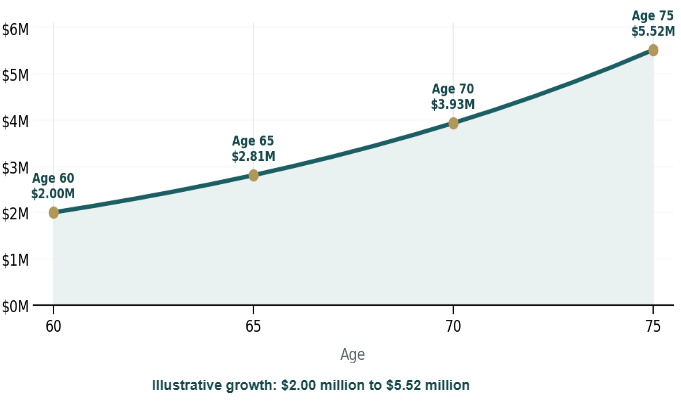
Hypothetical illustration. Assumes 7% annual growth, no withdrawals, no contributions, and no taxes or fees. Illustrative RMD calculated using the current IRS Uniform Lifetime Table factor of 24.6 at age 75 and assumes $5.52 million is the applicable prior December 31 balance. Actual results will vary.
Why a Growing IRA Balance Matters
The challenge for many affluent retirees is not simply the size of the IRA. It is that the account can continue growing during the years before required distributions begin.
In this illustration, a retiree who starts with a $2 million IRA at age 60 could see the balance grow to more than $5.5 million by age 75 under a steady 7% annual return assumption. Using today's IRS Uniform Lifetime Table, that balance could produce an initial required minimum distribution of roughly $224,000.
For some households, that is not a spending problem. It is a taxable-income problem.
A retiree may not need an additional $224,000 for annual spending, yet the taxable portion of the distribution generally must still be recognized as income. That income can arrive on top of Social Security, pensions, portfolio income, realized gains, rental income, or other taxable items.
What Is a Roth Conversion, and What Conversion Strategies Can Help?
A Roth conversion moves assets from a pre-tax retirement account to a Roth account and generally creates taxable income in the year of conversion. In this context, the objective is not to avoid taxes entirely. Instead, it is to evaluate whether recognizing some taxable income gradually over many years may create more flexibility than potentially recognizing larger amounts later through required distributions.
That flexibility comes with a current cost. Each conversion adds to taxable income, may affect Medicare premiums, and requires a plan for paying the resulting tax, often from cash or taxable investment assets. Whether converting makes sense therefore depends on more than the size of the IRA. The amount and timing should be evaluated against the household's current marginal tax rate, reasonably expected future tax exposure, available liquidity, charitable goals, and the potential impact of future required distributions.
Expecting to be charitable in retirement?
Qualified charitable distributions can serve as a Roth conversion alternative for households looking to manage IRA balances and future RMDs.
Married couples may also want to consider the survivor years. After one spouse dies, the surviving spouse may retain much of the same IRA and investment income while eventually filing as a single taxpayer. That does not automatically favor a Roth conversion, but it can make future distribution flexibility more valuable.
The Retirement Tax Window May Be Longer Than You Think
Many retirees are surprised to learn that required distributions do not necessarily begin at 70½ or 72 anymore. For individuals born in 1960 or later, current law generally pushes required minimum distributions to age 75. For the 60-year-old in this example, that creates roughly a 15-year period to evaluate conversion strategies and other income planning decisions before RMDs begin.
The window is about control
Before RMDs, the household may have more discretion over when to recognize taxable income. Once RMDs begin, part of that income decision becomes mandatory.
Those years may offer opportunities to evaluate:
- Partial Roth conversions.
- Strategic withdrawals.
- Charitable planning.
- Medicare planning.
- Tax diversification.
The exact opportunity varies by household, but the broader point is straightforward: more years can mean more flexibility over when and how taxable income is recognized.
AGE 60
Retirement Begins
Income may change. Establish the household's taxable-income baseline and identify which accounts are funding spending.
AGES 60–74
Annual Planning Window
Repeat each year: project income, evaluate partial conversions and withdrawals, coordinate charitable and Medicare considerations, and revisit the plan before year-end.
AGE 75+
RMD Years
For this example, required distributions begin. Planning shifts toward fitting required income into the rest of the household's plan.
The middle phase is an annual planning cycle, not a prescribed sequence of actions.
Four Decisions to Coordinate in Your Roth Conversion Strategy
The retirement window is not an instruction to convert every year. It is instead an opportunity to compare several income paths before required distributions reduce control over timing.
1. How much income is expected, and how much more should be recognized?
Pensions, Social Security, wages, business income, portfolio distributions, realized gains, and other items establish the baseline. Possible conversion amounts can then be modeled against marginal tax brackets and other income-sensitive thresholds with the assistance of a tax professional. The goal is not to fill a bracket mechanically, but to compare today's cost with future flexibility.
2. What funds will pay the conversion tax?
Using cash or taxable assets may preserve more of the converted amount inside the Roth account, but it also reduces liquid resources available for spending, reserves, or other opportunities.
3. Could the conversion affect Medicare costs?
A conversion can increase income used to determine income-related Medicare premiums. Because IRMAA generally relies on tax information from two years earlier, a conversion may affect premiums later. The marginal tax bracket is therefore only one measure of cost.
4. Do charitable goals change the use of IRA assets?
For a charitably inclined retiree, qualified charitable distributions or other giving strategies may influence how much of the IRA should be converted. These strategies serve different objectives and should be evaluated together rather than treated as interchangeable.
The decision is bigger than this year's tax bill
A conversion should be judged across future spending, distributions, Medicare, charitable giving, and survivor years. More is not automatically better simply because there is room in a bracket.
When Should You Wait to Do a Roth Conversion?
- Current income is already unusually high.
- A lower-income year is reasonably expected.
- You expect to move to a lower or no-tax state later in retirement.
- Cash to pay the tax is limited or needed for near-term spending.
- A meaningful portion of the IRA is intended for charitable use.
- The proposed conversion only appears attractive under narrow or optimistic assumptions.
Planning a Move to New Hampshire?
A change in state residency can affect the tax analysis around when to recognize income. For retirees planning a move to New Hampshire, the timing of that move is another factor to consider alongside a significant Roth conversion.
Frequently Asked Questions
What age do RMDs begin?
The starting age depends on birth year and current law. Individuals born in 1960 or later generally begin at age 75 under current law. Individuals born before 1960 are generally subject to required distributions beginning at age 73.
How is an RMD calculated?
Generally, divide the prior December 31 account balance by the applicable IRS life-expectancy factor. Many original owners use the Uniform Lifetime Table. A different table may apply, however, when the sole beneficiary is a spouse more than 10 years younger.
Is there an annual dollar limit on Roth conversions?
No. A conversion is not governed by the annual Roth IRA contribution limit. The practical constraint is usually the tax and planning effect of the amount converted.
Can I undo a Roth conversion after it is completed?
Generally, no. Under current law, Roth conversions made after 2017 cannot be recharacterized back to a traditional IRA. That makes planning the conversion amount carefully before proceeding particularly important.
Can a Roth conversion affect Medicare premiums?
It can. A conversion may increase the income used to determine income-related Medicare premiums, which generally rely on tax information from two years earlier. The effect depends on the household's income and the applicable rules.
Can charitable giving reduce future IRA balances?
For an eligible IRA owner, a qualified charitable distribution may direct IRA assets to an eligible charity and can count toward an RMD under applicable rules and subject to annual maximum distributions.
Do Roth IRAs have lifetime RMDs?
Under current IRS rules, an original Roth IRA owner is not required to take lifetime distributions. Beneficiaries may be subject to distribution rules.
Should a retiree convert every year before RMDs?
Not automatically. Income, markets, deductions, cash needs, charitable plans, and tax rules change. The amount and timing should be revisited each year rather than repeated mechanically.
How Large Could Your Future RMD Be?
Today's IRA balance may not reveal the scale of tomorrow's required income. A multi-year Retirement Tax Window Analysis can illustrate how account growth, potential RMDs, Roth conversions, charitable plans, Medicare considerations, and cash-flow needs may interact across different conversion strategies and income scenarios.
Start With the Future RMD
Schedule a conversation with Monadnock Private Wealth, a New Hampshire-based wealth management practice, to explore how these decisions fit within your broader financial plan.
Sources and Important Notes
Sources: IRS Publication 590-A, Contributions to Individual Retirement Arrangements; IRS Publication 590-B, Distributions from Individual Retirement Arrangements; IRS guidance and final regulations on required minimum distributions; IRS Roth IRA and IRA FAQ guidance; Social Security Administration guidance on modified adjusted gross income and Medicare income-related monthly adjustment amounts (IRMAA).
Hypothetical illustration disclosure: The example is illustrative only and is not a projection or guarantee. It assumes a constant 7% annual return, no withdrawals, no contributions, and no taxes or fees. Actual returns fluctuate, and actual results will differ.
Educational and tax disclosure: This material is educational and does not constitute tax, legal, or investment advice. Tax and legal matters should be reviewed with the client's external tax and legal professionals.
A Roth Conversion may not be right for everyone. There are a number of factors taxpayers should consider before converting, including (but not limited to) whether or not the cost of paying taxes today outweighs the benefit of income tax-free Qualified Distributions in the future. Before converting, taxpayers should consult their tax and legal advisors based on their specific facts and circumstances.
Although this strategy has existed for many years, the IRS hasn't provided formal guidance on whether it violates the "step-transaction rule." (When applied, this rule treats a multi-step transaction as if it was a single transaction for tax purposes.) The lack of a definitive ruling means there is some risk involved. So, bottom line, if you use a Roth Conversion Strategy (backdoor Roth strategy) solely to sidestep the earnings limits on Roth IRA contributions, you should be aware of the risks and seek the counsel and support of a tax professional.
A 10% penalty tax will apply on funds converted to a Roth if those funds are withdrawn before five years have elapsed unless the owner is age 59½ or another exception applies.